0
min read
July 20, 2026
The Deflection Trap: Why AI Support Automation Isn't Solving the Real Problem

Pat Osorio
There's a dangerous assumption spreading through customer service: that more AI-handled interactions equals better customer experience. It doesn't. And if you're investing in AI support automation to handle more conversations, you may be optimizing the exact wrong thing.
Zendesk's recent data on Jevons Paradox illustrates the trap perfectly. As AI lowers the cost of support, companies invest heavily in customer service AI to handle more conversations, and they celebrate it. The numbers look impressive: interaction volume doubled, hiring barely changed, agent workload jumped 87%. But celebration masks a hard truth. Most support interactions exist because something broke upstream, and throwing support automation at them won't fix it.
An onboarding flow confused customers. A payment failed unexpectedly. A feature wasn't intuitive. A policy wasn't clear. A bug reached production. These aren't unavoidable. They're preventable. If AI lets you handle twice as many preventable interactions, you haven't improved the experience. You've just become better at servicing symptoms.
The Real Cost of the Deflection Game
Here's what a spike in workload actually means: you've scaled support capacity without scaling down the underlying friction. That's not a win. It's a warning signal. Each additional interaction represents a customer moment where your product or process didn't do its job. And each one is a moment you lost the chance to build loyalty, upsell, or prevent churn.
Consider the math (illustrative). A fintech sees 50,000 support tickets a month. With AI automation, it can now handle 100,000, and cost per ticket drops from $8 to $2. Success, right? Not really. Those extra 50,000 tickets represent friction that still exists. Say 40% are preventable: onboarding confusion about compliance, unclear transaction limits, payment failures, KYC/AML misunderstandings. That's 20,000 conversations that cost real money:
- Lost expansion revenue. Confused customers don't increase transaction volume or upgrade tiers.
- Increased churn. Customers who hit friction during onboarding or their first transaction are far more likely to abandon the platform.
- Regulatory and compliance risk. Every compliance-related interaction is a chance for miscommunication, and compounded across thousands, it creates liability.
- Damaged brand perception. In fintech, trust is everything. Every friction point undermines confidence in your platform.
So yes, you're handling more tickets, cheaper. But you're leaving real money on the table. The real question isn't “Can we handle 87% more conversations with the same headcount?” It's “What if we prevented half of them entirely?”
Case Study: Deflection vs. Prevention
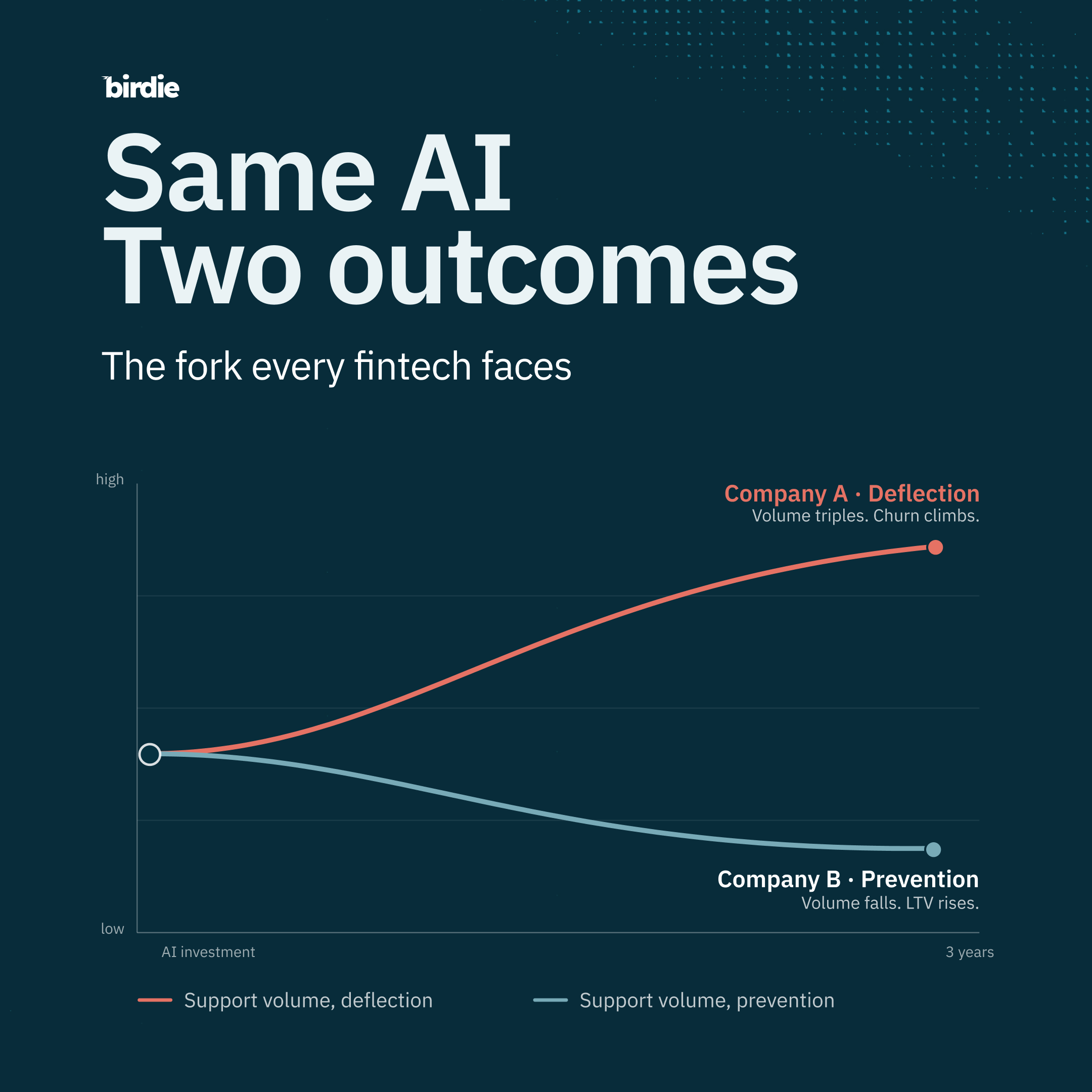
The comparison below is an illustrative scenario, a composite of patterns we see across fintech support data, not a single named customer or audited result. The figures show the shape of the difference, not a benchmark to quote.
Company A: The Deflection Play
They implement an AI support agent. Response time drops from 4 hours to 2 minutes. First-contact resolution improves from 35% to 62%. They celebrate the 27-point jump. But what actually happened? They're resolving more tickets without solving the underlying problems. Customers still get confused during KYC. They still hit errors on their first transaction. The account-opening flow is still unclear. They're just getting faster answers about the problem, not eliminating it.
Three years later: support volume has tripled. Despite AI automation, they've hired 15 new specialists. Satisfaction plateaued at year one. Churn is climbing, especially in the first 30 days. The C-suite is frustrated. They invested in support automation, and it didn't move retention, transaction volume, or revenue.
Company B: The Prevention Play
They implement the same AI support agent, but they use it differently. Instead of optimizing for speed and resolution rate, they use customer signals to identify patterns. They discover their ticket volume breaks down roughly as:
- KYC verification confusion, around identity document requirements (largest share)
- Questions about why a transaction was declined (fraud rules unclear)
- Clarification on account tiers and limits
- Recurring system failures that keep resurfacing
- Regulatory and compliance questions where customers need reassurance
Now they prioritize fixes instead of faster answers:
- Redesign the KYC flow with clearer guidance.
- Make transaction-decline reasons transparent, showing customers exactly why.
- Create visual tier comparisons and limit documentation.
- Fix the recurring system failures at the root.
- Build a compliance FAQ and automated policy guidance.
Within six months, support volume falls even as customers grow. Activation improves because more customers complete KYC on the first attempt. Fewer transaction failures mean higher transaction volume per user. More customers confidently upgrade tiers. Higher first-month activity predicts stronger long-term retention. Three years on: support volume is stable despite major customer growth, churn runs well below market, and lifetime value is up. The CFO is happy, because support automation didn't just cut headcount. It reshaped the model.
The difference? Company B didn't use AI to scale support. It used customer signals and customer intelligence to prevent the need for support.
This is the closed-loop move in practice: turning a signal into a shipped fix rather than a faster reply. (See our article about closed-loop model)
Where AI Actually Changes the Game
Support data is the richest source of customer intelligence most companies have. Every ticket is a signal. Every pattern is a clue about where your product or process is breaking. Most companies treat those signals as artifacts to optimize: faster response, higher automation, lower handling cost. That's the deflection game. But what if you inverted it?
The Prevention Framework
- Capture signals across every touchpoint: support tickets, chat logs, KYC data, onboarding funnels, transaction failures, churn surveys, compliance questions.
- Identify patterns at scale. Not just “customers are confused” but “users who fail KYC on the first attempt churn quickly” or “first-day transaction declines predict higher 30-day churn.”
- Connect patterns across the org, so Product knows which flows to redesign, Engineering knows which failures to prioritize, Operations knows which policies to clarify, and CX knows where to focus.
- Systematically eliminate the reasons customers need support in the first place.
When you see 500 customers stuck on KYC, you don't hire faster specialists. You redesign the flow. When declines tank retention, you don't automate the explanation. You fix the decline experience. When the same compliance question is asked 10,000 times, you don't write a playbook. You redesign the feature so the requirement is obvious.
“But We Already Tag and Route Everything”
This is the objection worth taking seriously, because most teams genuinely do have AI support, tagging, and routing in place. Here's the distinction. Tagging tells you a ticket happened and sends it somewhere. Prevention asks why the ticket existed and removes the cause. A tag closes a conversation. A signal, connected across Product, Engineering, and Ops, closes a gap.
Routing and automation make the deflection loop faster. They don't make it smaller. If your dashboards measure handle time, resolution rate, and deflection rate, but not tickets prevented, you're still playing Company A's game, just more efficiently. The shift isn't a better ticketing workflow. It's treating support as a business-intelligence function, not a cost center.
The Business Case for Prevention
Better unit economics. Every interaction costs money, whether it's a $20/hour agent or a $0.05 AI token. Preventing interactions is cheaper than automating them.
Higher retention. Customers who hit fewer friction points churn less. Removing the causes of support tickets is a direct line to reducing churn.
Faster growth. Customers who onboard smoothly and reach their goals without friction expand, refer, and renew.
Defensible position. While competitors race to automate more support, you build products that need less of it, a fundamentally different advantage.
Organizational alignment. A customer context platform that connects signals across teams creates genuine cross-functional alignment around customer outcomes.
The Companies Winning Right Now
The companies winning right now aren't the ones with the fastest support automation. They're the ones using customer signals to systematically prevent problems. That's not a support function. It's a business-intelligence function. And it's where AI actually changes the game.
Most vendors selling support automation promise you'll handle more tickets with fewer people. Technically, they're right. But that's optimizing the wrong thing. The real opportunity is a customer context platform, a unified system that connects customer intelligence across support, product, onboarding, payments, and operations, so you can systematically reduce the problems that generate tickets in the first place. That's not a cost center. That's a revenue engine.
Because the best customer service interaction is still the one that never had to happen.
See how Birdie turns support signals into prevention. Book a walkthrough →
Get started
Unlock the power of CX intelligence with our Customer Intelligence and Frontline Intelligence platform.

What is support deflection in customer service?

Support deflection is using AI automation to resolve or contain more customer interactions without a human agent, measured by metrics like deflection rate and handle time. It lets a team handle far more tickets at a lower cost per ticket, but it addresses the symptom rather than the reason the ticket exists. The approach optimizes the wrong thing when most tickets come from preventable upstream friction.
How does a prevention approach to support work instead of deflection?
Instead of optimizing for speed and resolution rate, you use support signals to find the patterns behind tickets, such as customers failing identity verification or hitting unclear transaction limits. You capture signals across every touchpoint, identify patterns at scale, connect them across Product, Engineering, and Operations, then fix the root cause. When 500 customers get stuck on the same step you redesign the flow rather than hiring faster agents.
What is the difference between deflection and prevention in customer support?
Deflection makes the support loop faster by resolving or containing tickets, while prevention makes the loop smaller by removing the reason tickets happen. Tagging and routing tell you a ticket occurred and send it somewhere; prevention asks why it existed and eliminates the cause. One treats support as a cost center to optimize, the other treats it as a business-intelligence function.
Does handling more tickets with AI actually improve customer experience?
Not on its own; in the pattern the article cites, interaction volume can double while agent workload jumps 87 percent, which signals unresolved friction rather than a better experience. Each extra interaction is a moment your product or process did not do its job, and a share of them are preventable onboarding, payment, or compliance issues. Handling them faster and cheaper still leaves lost expansion revenue and higher churn on the table.
We already tag and route everything with AI, isn't that enough?
No, because tagging and routing make the deflection loop faster without making it smaller. A tag closes a conversation; a signal connected across Product, Engineering, and Operations closes the gap that created the ticket. If your dashboards track handle time, resolution rate, and deflection rate but not tickets prevented, you are still servicing symptoms more efficiently.
Does prevention mean I no longer need AI support automation at all?
No, AI support automation still has a role; the point is to change what you optimize it for. Support data is the richest source of customer intelligence you have, so the automation should feed a system that identifies patterns and drives fixes, not just faster replies. Some interactions will always need a fast, well-handled answer, but the best interaction is the one that never had to happen.
See Birdie in action.
See how Birdie turns customer signals into retention, expansion, and adoption decisions. 30 minutes. Live demo with outcomes.