Listen to every signal. Act on the ones that matter.
Aggregate feedback from surveys, reviews, NPS, support chat, and calls. Governed Al diagnoses what each signal means, connects it to business impact, and surfaces what to fix first - before your next board meeting.
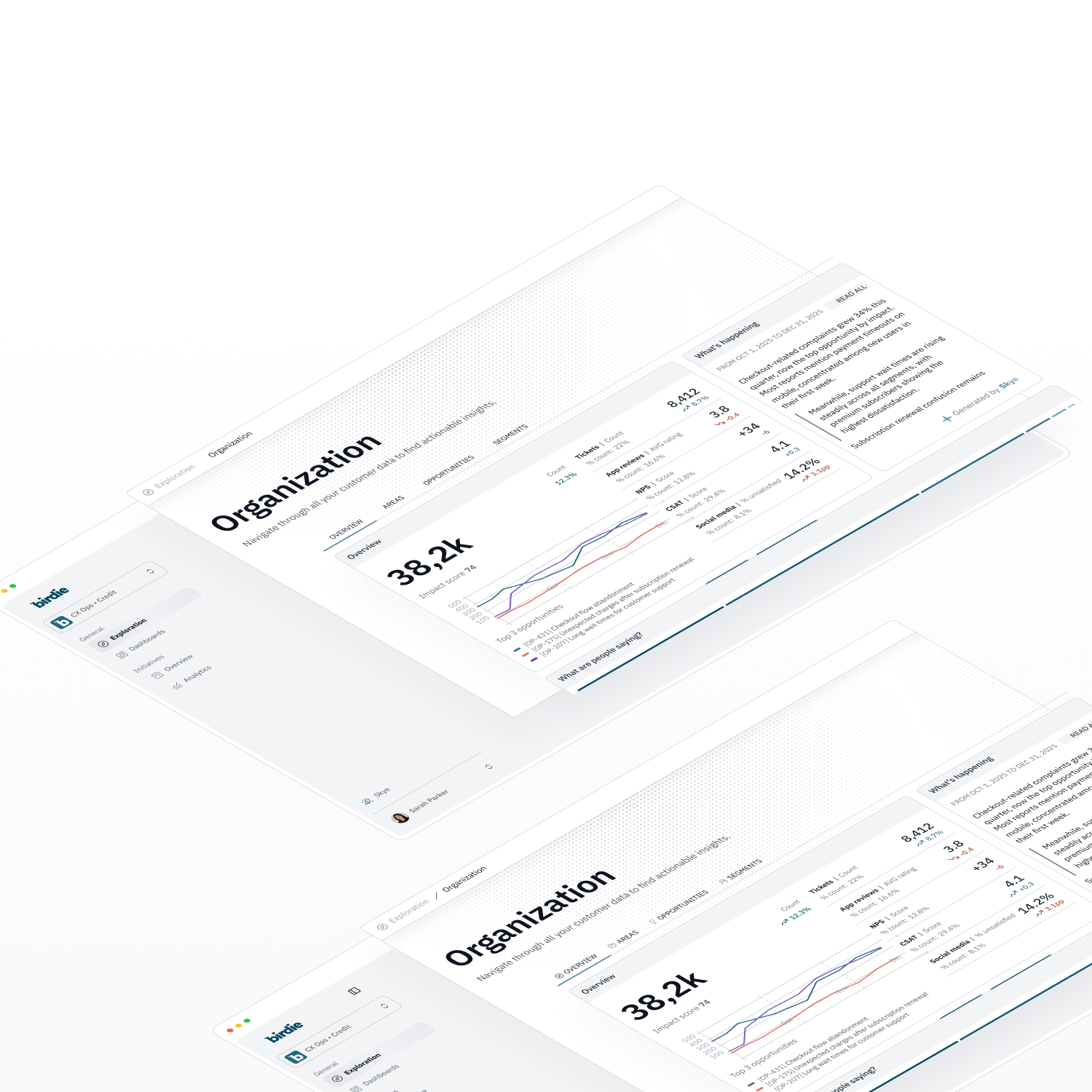
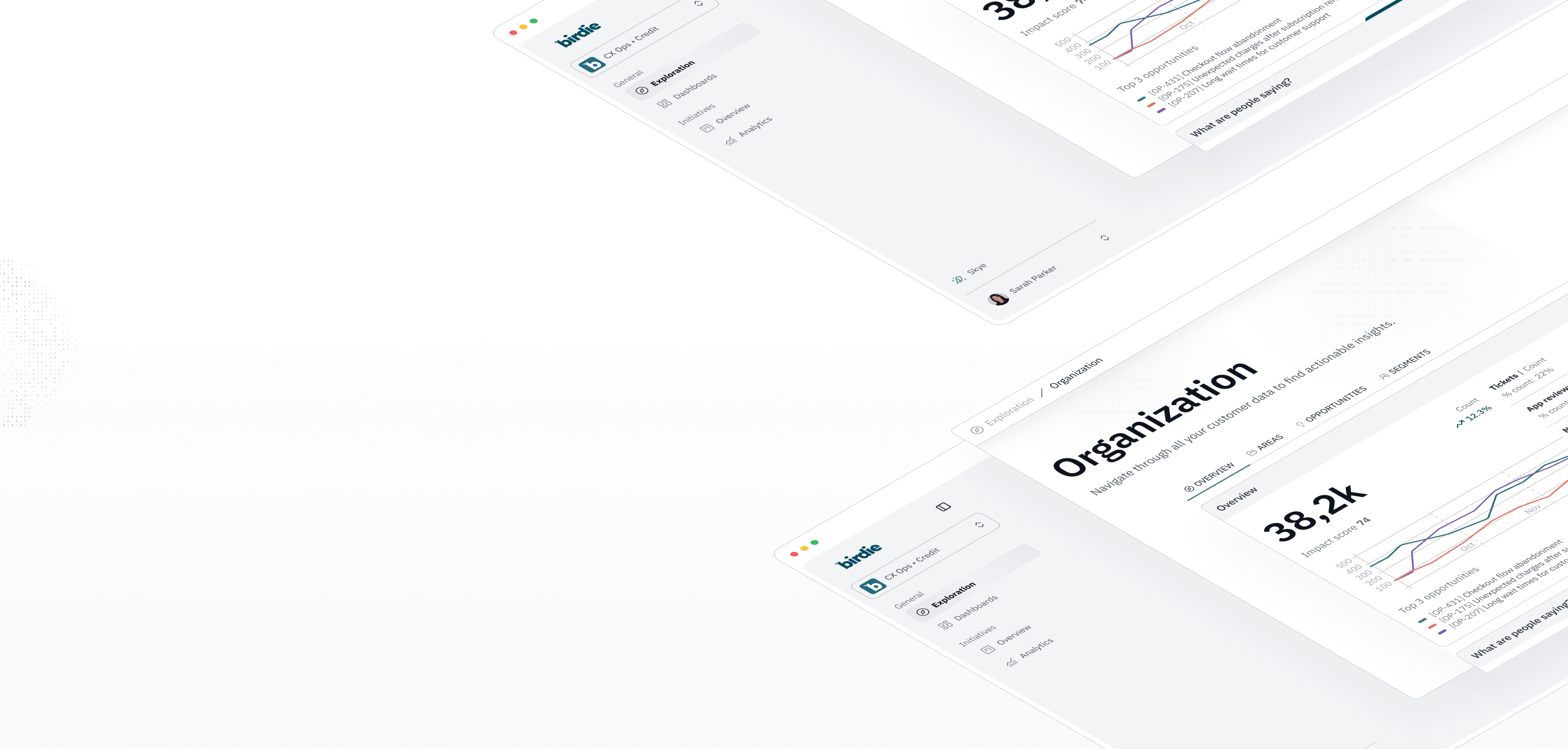




Most VoC Programs Generate Data, Not Direction
Feedback arrives from every direction - surveys, support tickets, reviews, call recordings. But without a unified view or a clear line to business outcomes, it stays noise. Customer problems keep recurring while teams debate what to prioritize.

Fragmented signals, no shared picture
Feedback lives in surveys, tickets, reviews, and call recordings —all siloed, all speaking a different language. Without a unified view, patterns stay invisible and teams work from different versions ofthe truth.

Reactive by design
By the time feedback reaches the right team, the customer has already decided. VoC tells you what went wrong - after the detractor has left, after the churn has happened. There's no early signal, only confirmation.

You fix the wrong things
A score drops. You don't know if it's a team behavior, a broken process, or a product gap. Without root-cause clarity, teams act on guesswork - solving symptoms while the real problem keeps showing up in the next survey.

High effort, unclear ROl
Turning raw feedback into insight takes days of manual work. And even when teams act on it, there's no way to know which changes moved the needle - or which problems are quietly coming back.
Manage your taxonomy with transparency
Maintain full visibility and control over how customer feedback is structured. Review, refine, and evolve your taxonomy as new signals emerge so insights stay aligned with business reality.
Schedule a demo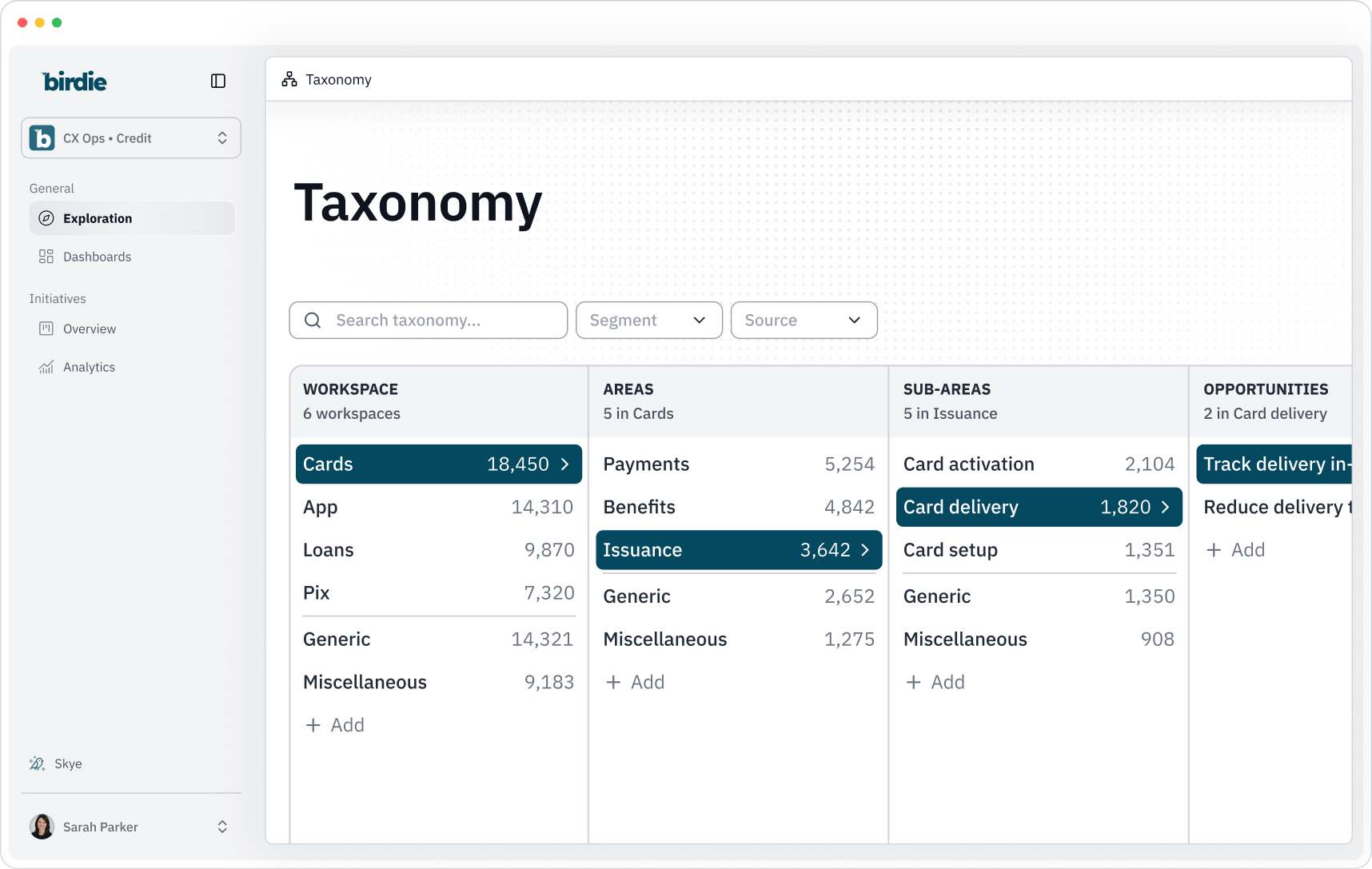
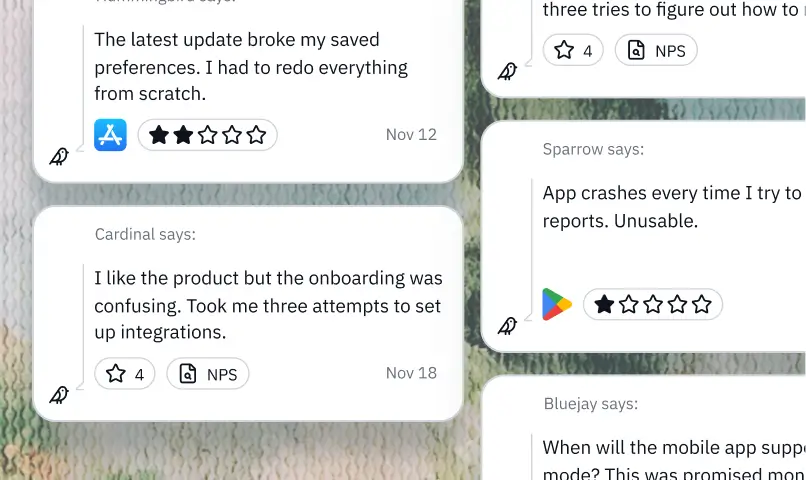

Connect every customer signal
Unify feedback from every channel in one place, from surveys and reviews to support tickets, chats, and calls, so teams can analyze the full voice of the customer.
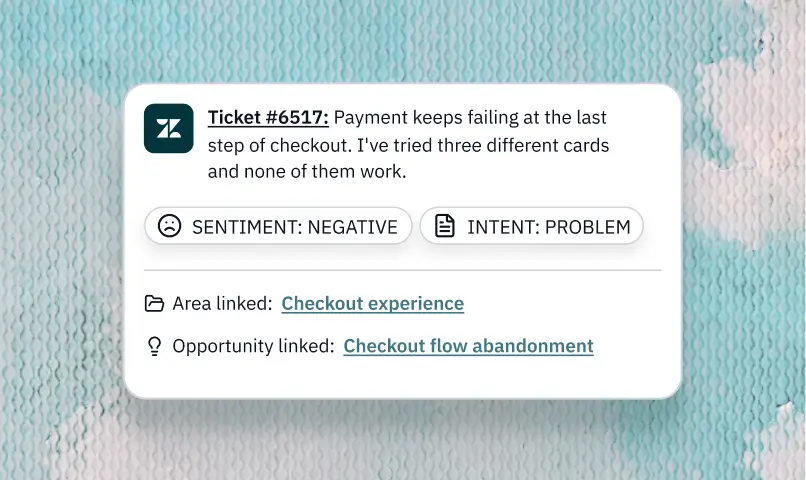

Standardize feedback across sources
Equalize feedback across channels, formats, and teams to create consistent intelligence you can trust for reporting, prioritization, and decision-making
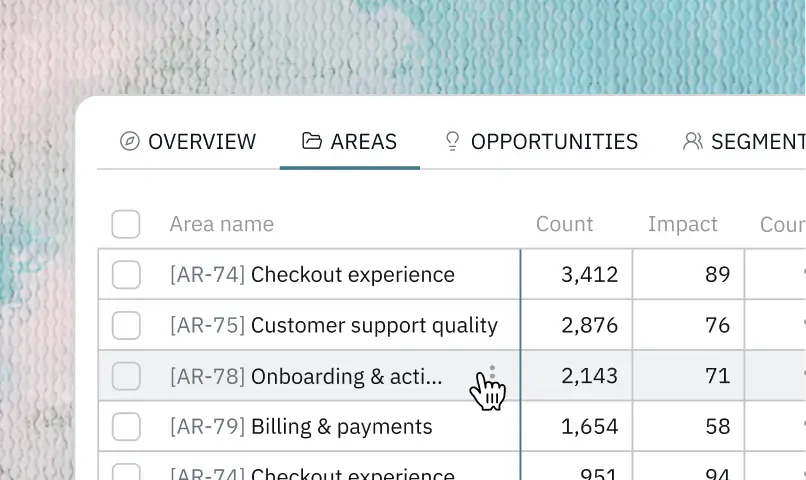

Give every team one source of truth
Create a shared foundation for CX, Product, and Operations with one consistent view of customer feedback, issues, and opportunities across the business.
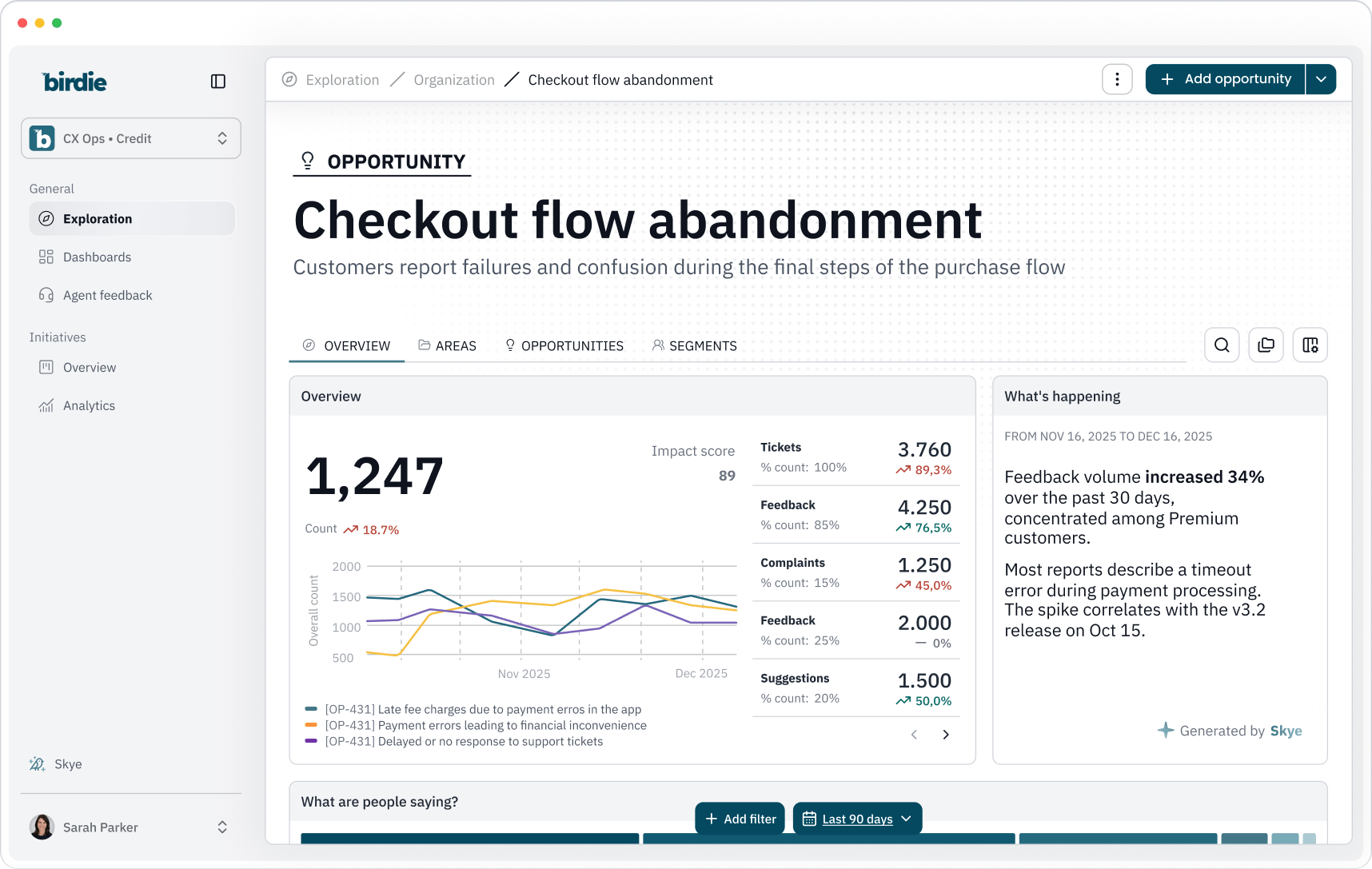
Understand opportunities and root causes
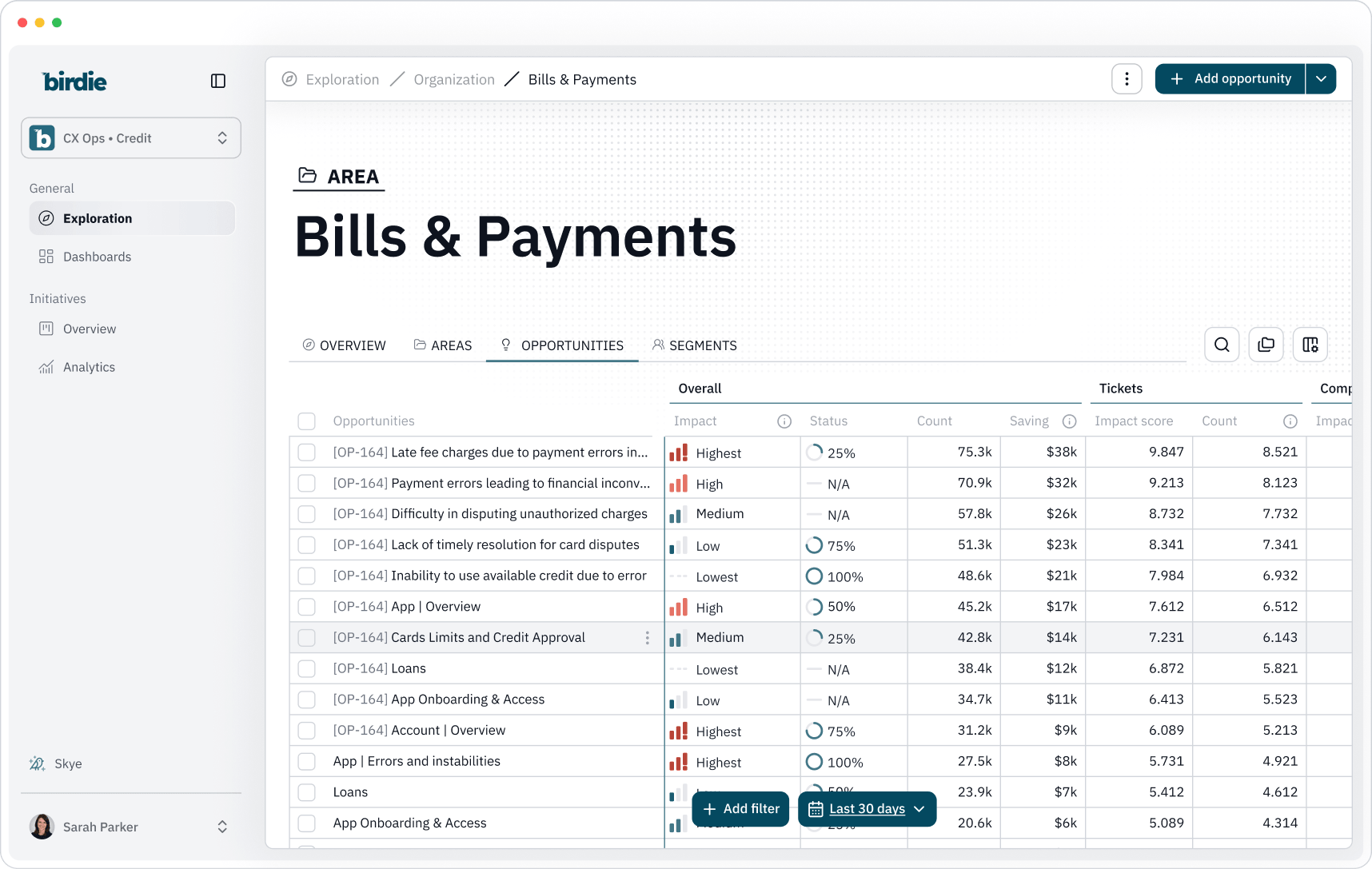
Group customer signals into clear opportunities and uncover the root causes behind each issue, including what is happening, why it happens, and how often it appears.
Schedule a demo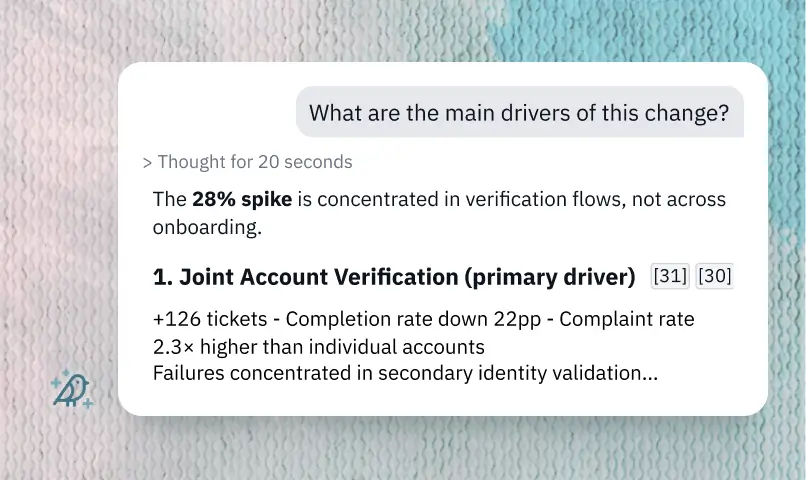

Ask questions, get instant answers
Use Skye, Birdie's Al assistant, to explore customer signals in seconds. Ask about churn, NPS drivers, or priorities and get instant answers across allyour data.


Detect issues automatically
Continuously monitor customer signals and receive automated digests or alerts when new issues emerge, problems grow, or anomalies and spikesare detected.


Explore who is affected
Analyze issues across customer segments, lifecycle stages, product usage, and churn risk to understand where impact is highest and where to focus next.
Stack-rank opportunities by impact
Prioritize the opportunities most likely to affect churn, revenue, and cost-to-serve so teams can focus on the actions that drive the biggest business impact.
Turn insights into initiatives
Route actions to the right teams
Size and monitor hypotheses with Al
Monitor experience over time
Track how customer experience evolves as teams launch improvements, with continuous monitoring of trends, emerging issues, and changes in key metrics.

Build dashboards for every team
Create dashboards tailored to each team so CX, Product, and Operations can monitor and act on the customer signals and PIs that actually matter to them.

Prove ROl by initiative
Measure the business value of eachinitiative by connecting actions taken to shifts in customer sentiment, churn risk, retention, and operational performance.

Link improvements to outcomes
Show how better experience influence customer and business outcomes by tying feedback trends to metrics like churn, revenue, NPS, and cost-to-serve.
How VoC powers action at every stage
Birdie doesn't just surface insights — it routes the right signal to the right team, in the right format to act on it immediately.


Agents improve in the moment, not the next training cycle
Real-time nudges drawn from your actual conversation history help agents respond better before the interaction goes wrong — not after the survey comes back negative.


Fix the process this week, not this quarter
When a script, policy, or workflow is creating consistent friction, Birdie pinpoints it with evidence — so Ops can act with confidence instead of chasing assumptions.


Ship what customers actually need, backed by volume
Product teams stop relying on a handful of interviews or a squeaky customer to set the roadmap. Birdie gives them statistically grounded signal from the full conversation base.


The more you use it, the sharper it gets
Birdie's models learn from your corrections and your outcomes over time — so the intelligence compounds. What took analyst hours in month one becomes automatic by month three.


Integrate the Systems Behind Customer Experience
Connect feedback, behavior, customer profiles, and operational systems to create a complete view of customer experience.
Feedback Platforms
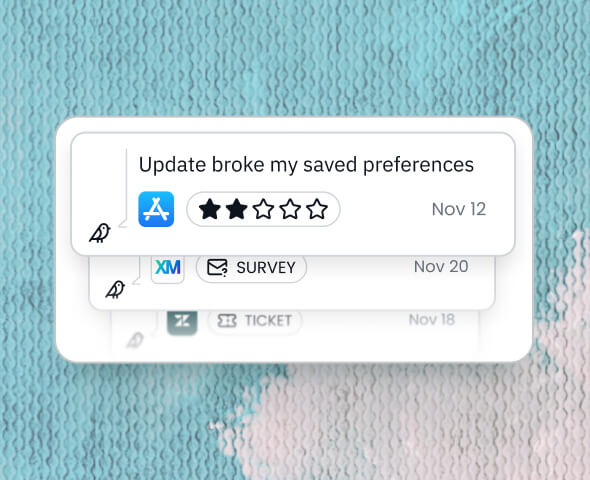
Bring in signals from surveys, support conversations, reviews, and community channels to understand what customers are saying across every touchpoint.
Behavioral Data
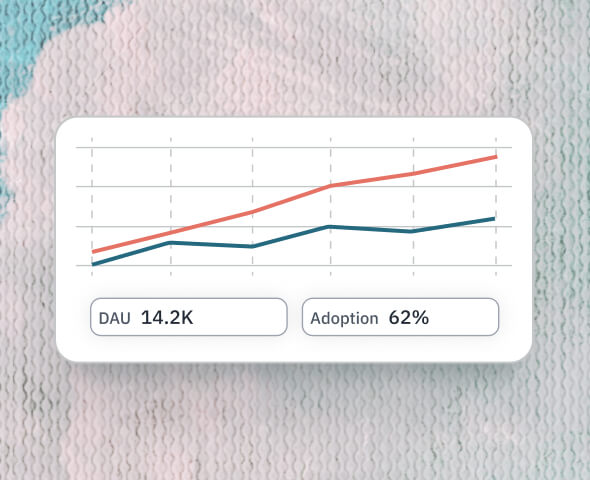
Connect product usage and behavioral analytics to understand how customers actually interact with your product.

Customer Profiles
Enrich signals with customer attributes like segments, lifecycle stage, revenue, and account data to understand who is affected by each issue.

Operational Systems
Send insights and initiatives directly into execution systems so teams can act without leaving their workflows.
Close the loop with Frontline Intelligence
Turn quality into a strategic system that improves customer experience and operational performance by connecting agents with voice-of-customer insights.
When decision velocity comes into play





Built for enterprises that can't afford to get it wrong
Security & Compliance
Birdie is built to the standards of regulated fintech and healthcare environments, anywhere in the world. Your customer data is encrypted, access-controlled, and audit-logged.
Accuracy & Transparency
We publish F1 scores. We show you model cards. We're explicit about accuracy limitations and edge cases. You know exactly what works, what doesn't, and why.
Availability & Support
99.9% uptime SLA. Dedicated enterprise support. Your decisions don't stop because your platform stopped. When you need us, we're here.


From signal to execution in one workflow.
Birdie connects to the systems where signals originate and the tools where work happens. Signals flow in from Zendesk, Slack, surveys, and reviews. Birdie diagnoses them. Decisions flow out to Jira, Asana, and your AI agents — with full context.
See IntegrationsWhat makes Birdie’s Customer Intelligence different from traditional Feedback Analytics or Voice of Customer tools?

Why is Birdie's AI customer intelligence better than other customer intelligence tools?
Birdie's AI layer analyzes intent, emotion, and, most importantly, context, not just keywords. It automatically identifies themes across millions of interactions and groups them into opportunity areas.
The difference from keyword-based tools:
- Context matters. "The app crashes when I try to pay" and "payment screen is broken" become the same issue, even though they share no words.
- New patterns surface automatically. You don't need to pre-define every category, Birdie detects emerging topics without manual rule creation.
- Calibration refines accuracy. Your team validates and adjusts the AI's categorization over time, teaching it your specific terminology and priorities.
Example:
These three tickets all describe the same issue but use different words:
- "The app crashes when I try to pay"
- "Payment screen is broken"
- "Can't complete checkout—keeps throwing an error"
Traditional keyword-based tools treat these as three separate issues. Birdie's AI recognizes they're all variations of the same payment flow problem and groups them under "Payment processing errors." Your team sees one unified opportunity instead of scattered fragments.
Why is Birdie's AI customer intelligence better than building my own solution?
Birdie beats an in-house build on three things that are hard to replicate without dedicated infrastructure: reproducible answers, full signal coverage, and a taxonomy that stays consistent over time. In independent testing on 136,864 marketplace reviews, a raw LLM reinvented its categories and named a different top issue on every run, with Top-10 overlap dropping to 0% run over run, while Birdie's structured approach held 100% overlap and scored an audited f-score of 95 against expert-labeled ground truth, versus 65 for an LLM with a bolted-on taxonomy. Wiring an LLM to raw signals takes a weekend, but keeping results consistent across millions of signals and every team becomes an ongoing engineering commitment most teams underestimate. Birdie ships that consistency, coverage, and governance already built and audited, so teams get the accuracy without owning the maintenance.
Can Birdie handle multiple languages?
Yes. Birdie processes customer feedback in 50+ languages (including Portuguese, Spanish, French, German, Italian, Japanese, Mandarin, and others) and normalizes all feedback into your primary analysis language. A complaint submitted in Portuguese appears alongside English feedback with consistent categorization and sentiment detection.
This is especially valuable for companies with international customer bases, regional support teams, or multilingual product user bases who need a unified view regardless of input language
How does Birdie Customer Intelligence connect customer feedback to business metrics?
Customer intelligence is only valuable if it connects to outcomes. VoC OS links every feedback theme to business metrics:
- Revenue impact: Estimated value of fixing the issue
- Churn correlation: Which customer segments are affected
- Support cost: Volume of tickets generated by this friction
- NPS/CSAT contribution: Impact on satisfaction scores
- And more
When you identify "credit limit complaints" as a top issue, you see the estimated ARR at risk, the customer cohorts affected, and the support tickets it's generating,not just a bar chart, but customer intelligence you can act on.
Example:
Your team identifies "payment flow friction" as a top issue in VoC OS (mentioned in 12% of complaints). VoC OS shows you:
- Affected customers: Primarily users in the checkout flow with monthly plans
- Revenue at risk: ~$280K ARR (based on cohort size and churn correlation)
- Support cost: 24,000 tickets/month at $4.5 per ticket = $108,000/month
- NPS impact: 18-point drag on NPS for affected segment
- Business case: Fix payment flow → save $280K ARR + $108K/month in support costs
Now your team can prioritize initiatives by actual business impact, not guesswork.
See Birdie in action.
See how Birdie turns customer signals into retention, expansion, and adoption decisions. 30 minutes. Live demo with outcomes.