


Coach your team to excellence. In real- time.
Listen to support interactions while they happen. Guide better responses. Measure coaching impact. Diagnose whether problems are product, process, or people.




Traditional QA misses what actually matters
Most QA programs generate scores and reports, but offer little insight into what octually drives customer experience or business outcomes, limiting QA to an operational role.

Limited and fragmented evaluations - even with Al
Most QA still relies on samples.not the full picture. Even Al moyscore Interactions in Isolation,missing brooder potterns.

Slow, reactive detection
Issues are found after they spread. By the time they appear in reports, friction, repeat, contacts, and costs are already rising throughout the operation.

No connection to business outcomes
Traditional Q4 measures compliance, but rarely showshow behaviors affect CSAT, retention, resolution, or ellicency.

Hard to scale meaningful insight across interactions
Manual reviews cover only a emall share of conversations. That limits visibility acroas taams, channels, ond vendors.
Define evaluation rubrics and behaviors at scale
Create customizable evaluation criteria that reflect your service standards. Measure behaviors consistently across teams, vendors, and channels
Schedule a demo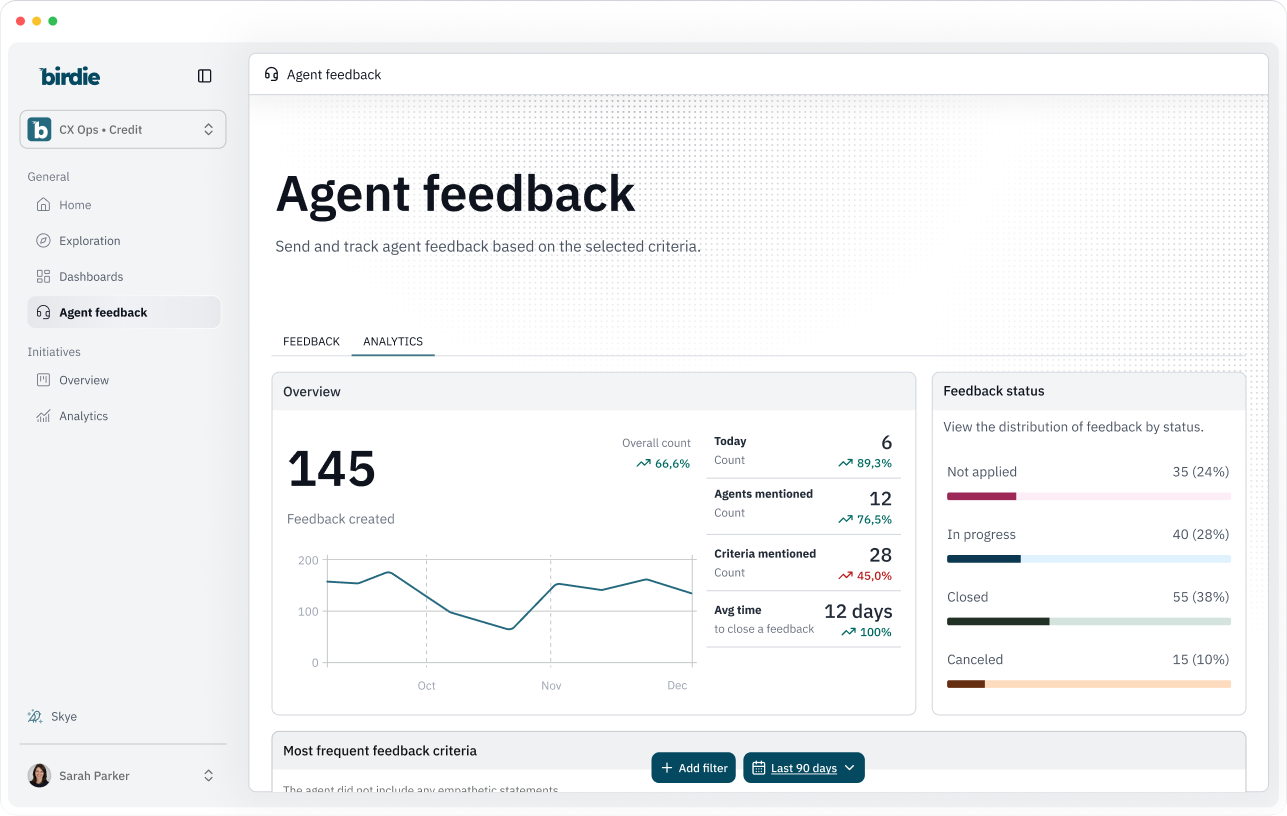
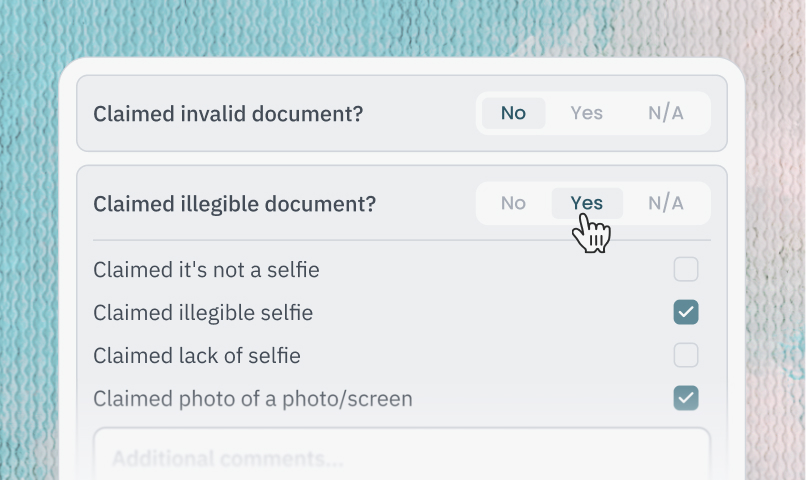

Create QA rubrics around what matters to customers
Build structured QA scorecards that go beyond internal checklists. Align evaluations with the moments and behaviors that shape customer experience.


Align quality monitoring with CX and business goals
Connect QA programs to the outcomes the business actually cares about. Measure service quality in a way that supports satisfaction, retention, and efficiency.
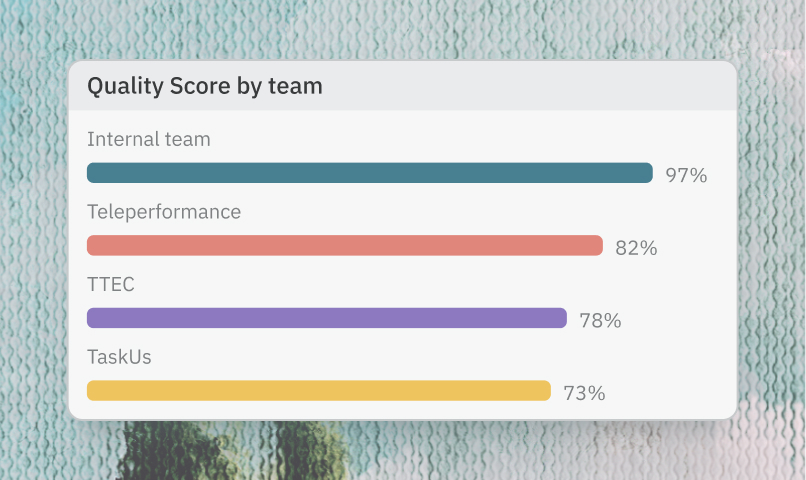

Ensure consistency across teams, supervisors, and BPOs
Standardize how quality is defined and evaluated across the organization. Give every team and partner the same service expectations and framework.
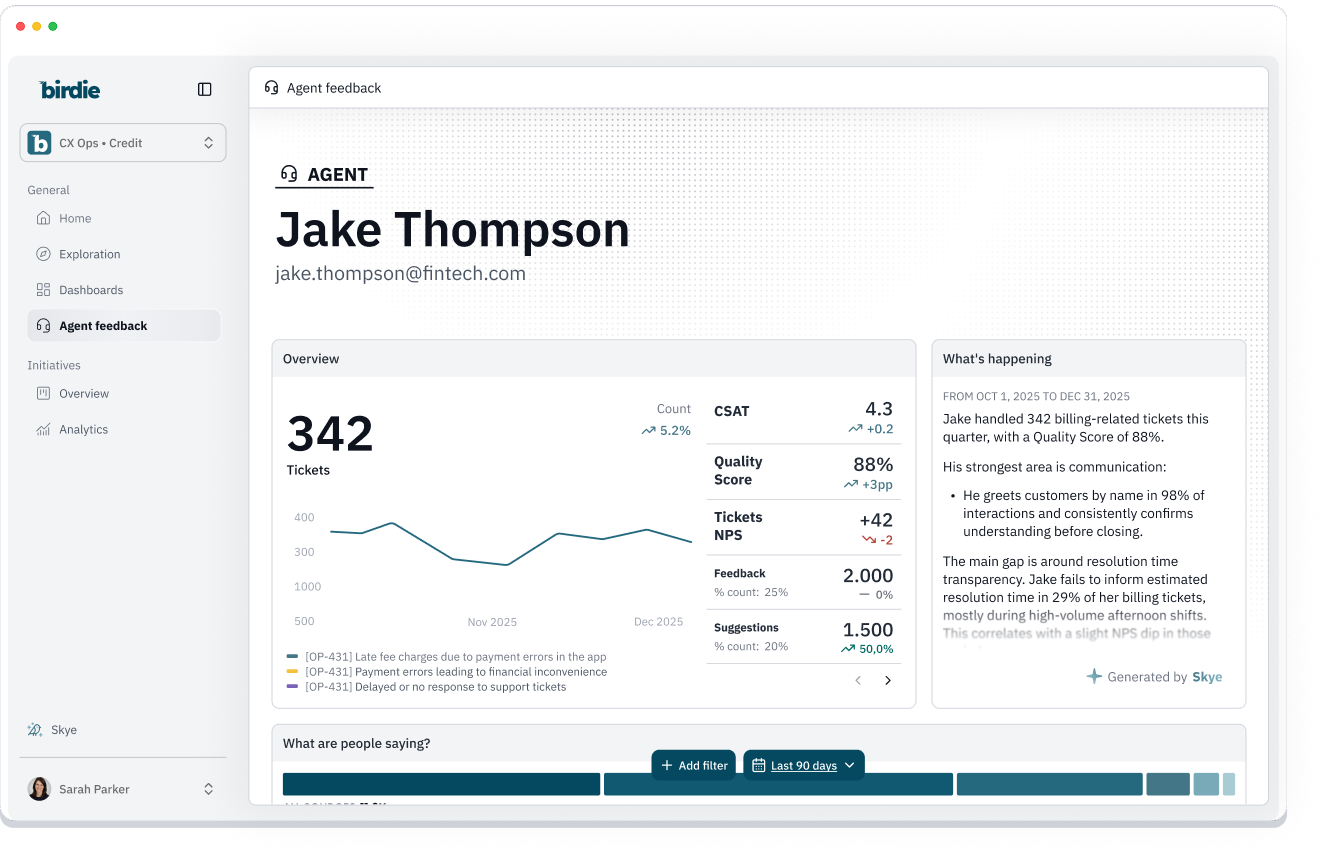
Correlate agent behaviors with CSAT, NPS, and resolution metrics
Understand which service behaviors actually affect customer outcomes. Connect quality signals with CSAT, NPS, churn indicators, and contact drivers.
Schedule a demo

Evaluate every interaction automatically
Replace manual sampling with AI-powered QA across 100% of conversations. Analyze interactions at scale across channels with automated scoring and risk detection.


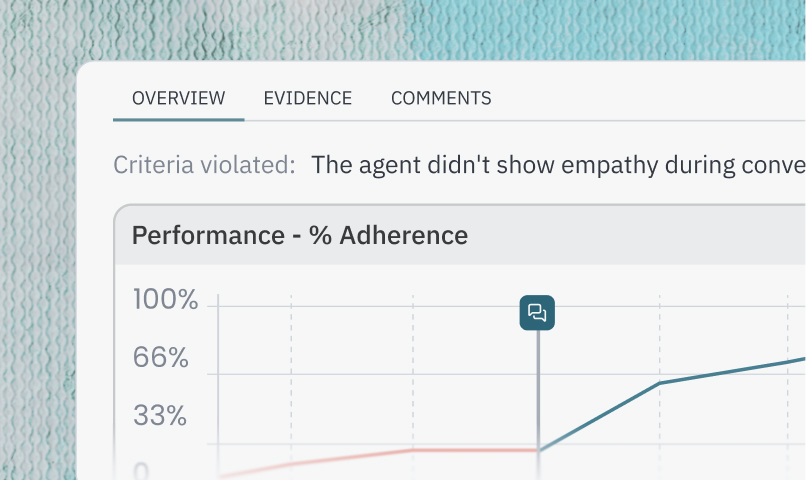
Understand root causes of performance gaps
Reveal what went wrong, why it happened, and how often it occurs. Analyze patterns across interactions to uncover the drivers behind service issues and dissatisfaction.

Explore performance by agent, team, BPO, or channel
Break down quality performance across the organization in the way operations actually run. Compare results by agent, supervisor, vendor, team, or support channel.
Prioritize the fixes support can’t solve alone
Connect service conversations with customer signals to uncover product and operational issues. Focus teams on the improvements that reduce friction and support workload.
Schedule a demo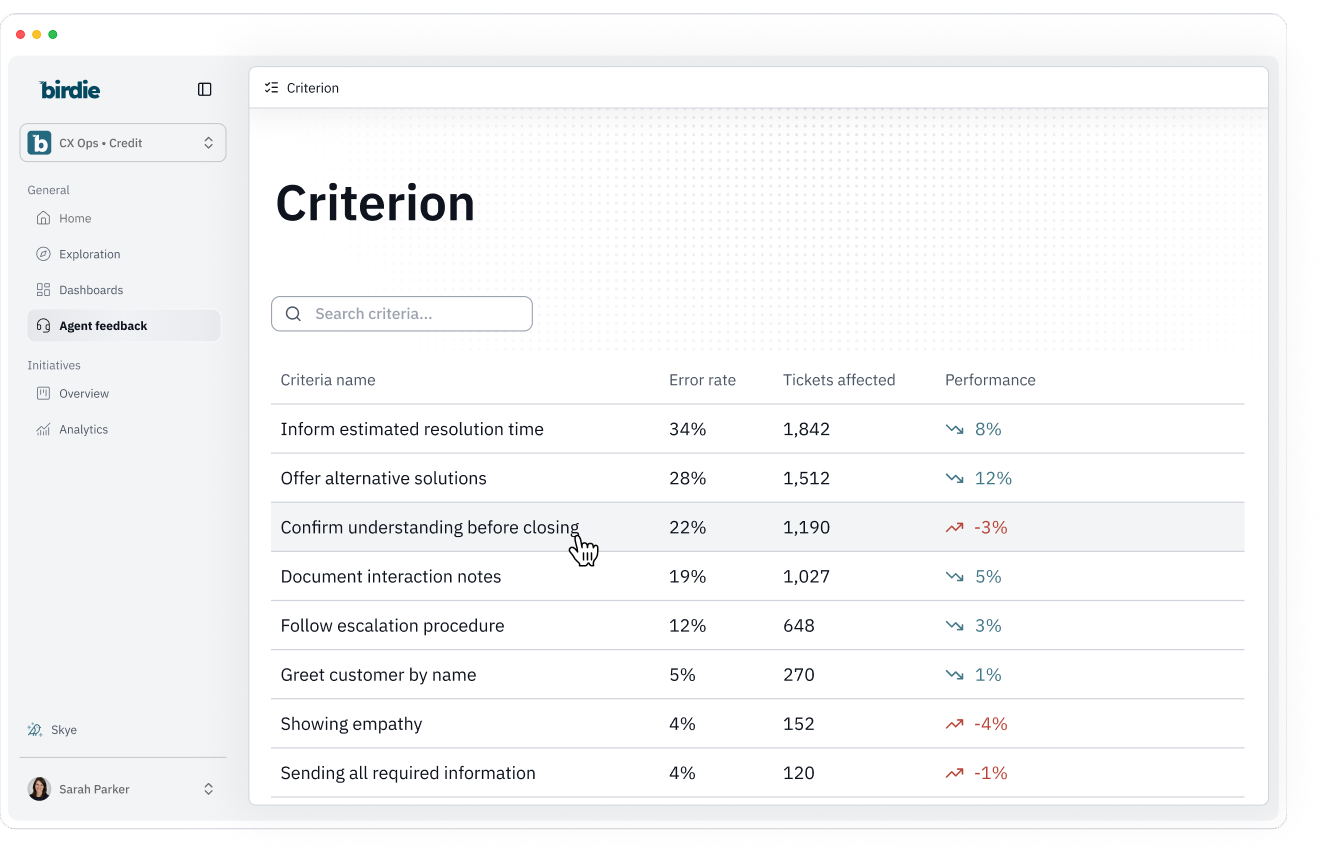
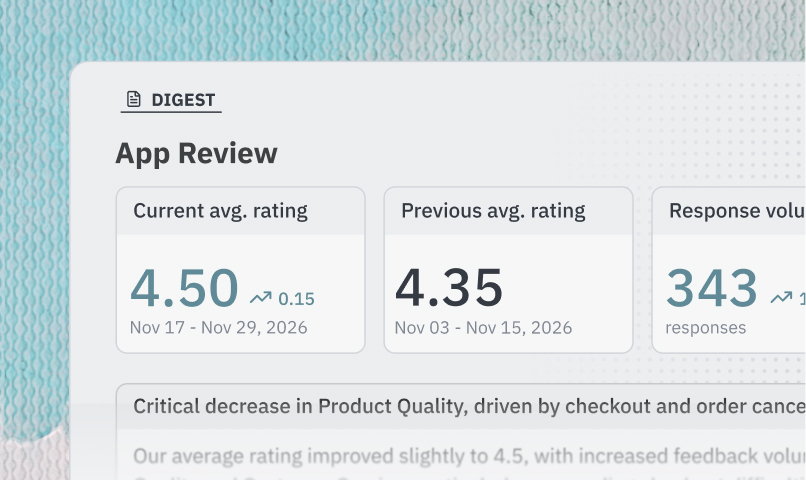
Detect risks and service failures early
Continuously monitor interactions for operational risks, policy violations, and service failures. Catch emerging issues before they escalate into larger customer problems.
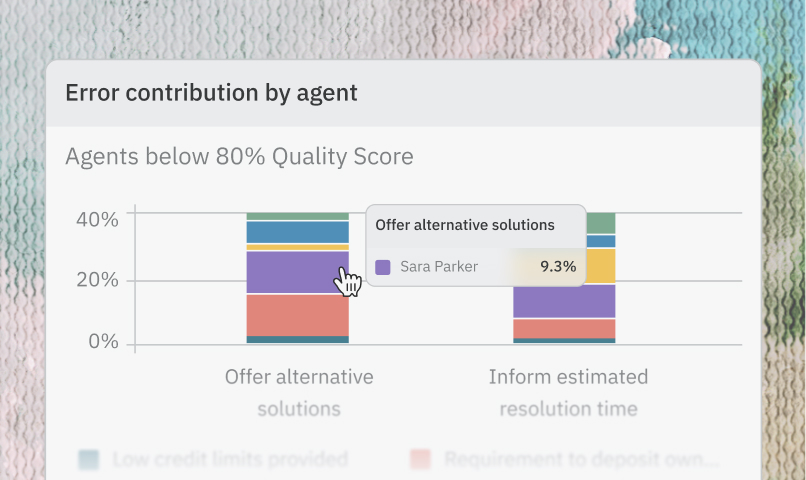
Identify the biggest improvement opportunities
Spot the behaviors, agents, and patterns with the greatest impact on quality. Help supervisors focus coaching where improvement potential is highest.

Turn insights into targeted action plans
Move from issue detection to clear next steps. Use quality insights to guide coaching, operational fixes, and cross-functional improvement efforts.

Scale coaching and performance management
Help supervisors coach more effectively with automatically surfaced opportunities. Generate guidance for agents using AI-supported feedback and full performance history.
Schedule a demo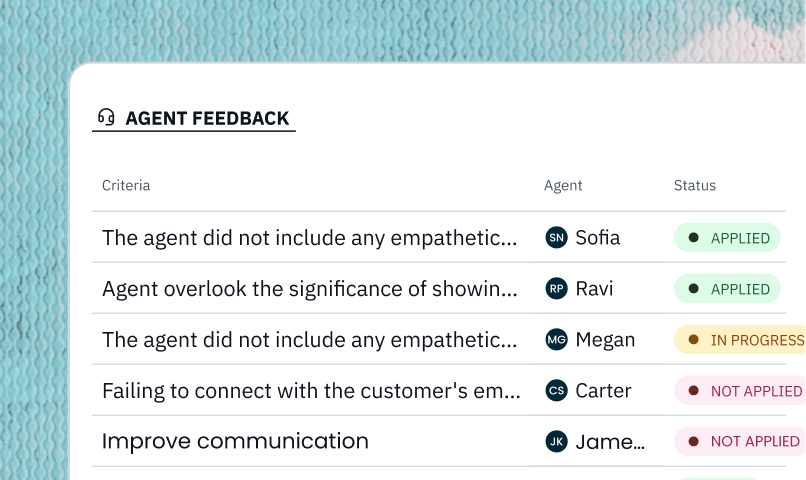
Provide clear feedback and guidance for agents and supervisors
Explain exactly why an interaction failed quality criteria and what should improve. Give teams clear guidance to resolve issues faster and coach with confidence.

Benchmark teams and BPOs
Compare performance across teams, regions, supervisors, and vendors. Identify inconsistencies and manage partner performance using objective quality data.
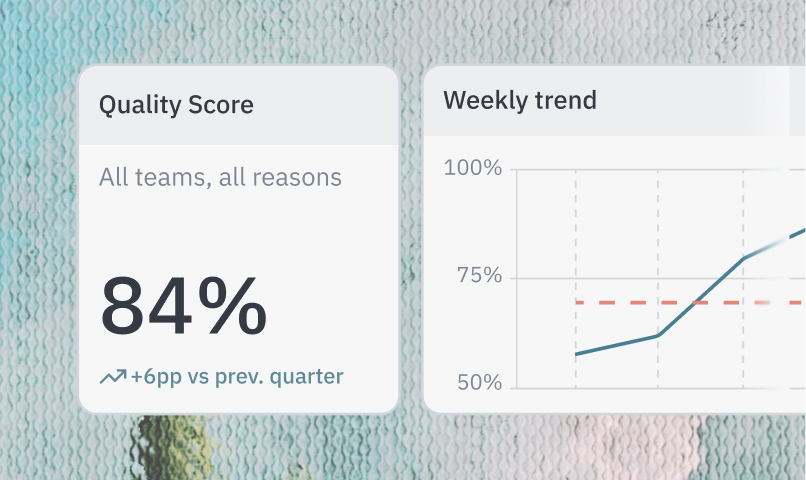
Monitor performance across the organization
Track trends across teams, channels, and vendors with real-time dashboards. Connect quality performance to customer experience and business outcomes over time.
Operation Benefits
Birdie analyzes every interaction, finds what matters, and turns it into measurable improvements across performance and cost.
Birdie vs Traditional QA
Traditional QA
Birdie Agent QA
Sample 2-10% of interactions
Analyze 100% for patterns
Report what happened
Predict what's next
Measure compliance
Prove business outcomes
Reactive quality checks
Proactive risk prevention
Improve quality scores
Drive CSAT, revenue, efficiency

Improve support consistency and boost satisfaction
Birdie identifies the behaviors that truly impact CSAT, NPS, and churn,helping teams reduce variability across agents and vendors.
Scale quality without scaling costs
Automated evaluations across 100% of interactions expand supervisor reach and eliminate manual bottlenecks.
Empower supervisors and agents
Provide clear, actionable insights that help teams improve faster and operate with consistent standards.

Prove the business impact of quality
Connect agent performance directly to revenue, retention, and operational efficiency.
When decision velocity comes into play


Built for enterprises that can't afford to get it wrong
Security & Compliance
Birdie is built to the standards of regulated fintech and healthcare environments, anywhere in the world. Your customer data is encrypted, access-controlled, and audit-logged.
Accuracy & Transparency
We publish F1 scores. We show you model cards. We're explicit about accuracy limitations and edge cases. You know exactly what works, what doesn't, and why.
Availability & Support
99.9% uptime SLA. Dedicated enterprise support. Your decisions don't stop because your platform stopped. When you need us, we're here.


From signal to execution in one workflow.
Birdie connects to the systems where signals originate and the tools where work happens. Signals flow in from Zendesk, Slack, surveys, and reviews. Birdie diagnoses them. Decisions flow out to Jira, Asana, and your AI agents — with full context.
See IntegrationsWhat is Agent QA, and how does it differ from traditional QA scorecards?

Agent QA is Birdie's AutoQA solution, it automates the quality scorecard process that QA teams have traditionally done manually.
In a manual QA program, evaluators listen to a sample of calls (typically 2-5%), fill out a scorecard or rubric, and provide feedback. The problem: you're making decisions based on a fraction of reality.
Agent QA evaluates 100% of interactions automatically:
- Every call, chat, and email is scored against your custom rubric
- Scoring is consistent, no evaluator bias or fatigue
- Results are available immediately, not weeks later
- Coaching opportunities surface automatically based on scorecard trends
Think of it as your QA scorecard, powered by AI, applied to every conversation.
How do I build a QA scorecard in Birdie?
Agent QA uses customizable scorecards (sometimes called rubrics) that reflect your quality standards. You define the criteria, Birdie's AI scores against them.
Common scorecard categories include:
- Greeting and sign-off: Did the agent follow your brand script?
- Empathy and tone: How did the interaction feel to the customer?
- Accuracy: Was the information provided correct?
- Resolution: Was the issue actually solved, or just closed?
- Compliance: Were required disclosures and protocols followed?
- Upsell/cross-sell execution: For revenue-generating support teams
You can weight categories differently based on what matters most. Birdie's AI then applies your scorecard to every interaction, not a sample.
How is Agent QA different from other AutoQA software?
Most AutoQA tools stop at scoring. They tell you which agents performed well and which need coaching. That's useful, but incomplete.
Agent QA connects quality scores to customer outcomes:
- Which agent behaviors correlate with higher CSAT?
- Which script deviations predict churn?
- Which compliance gaps create regulatory exposure?
- Which coaching investments actually move retention metrics?
Because Birdie combines AutoQA (Agent QA) with voice of customer analysis (VoC OS), you see both sides: how customers feel and how your team responds. Most automated quality management platforms only show you one half.
Can Agent QA replace my manual QA process entirely?
Agent QA automates the repetitive parts of quality management, scoring interactions, flagging issues, identifying patterns. But it doesn't eliminate the need for human judgment.
Here's how teams typically restructure:
Before Auto QA:
- QA analysts spend 80% of time listening and scoring
- 2-5% of interactions reviewed
- Coaching based on small, potentially unrepresentative samples
After Auto QA:
- AI scores 100% of interactions against your rubric
- QA analysts focus on calibration, edge cases, and coaching
- Coaching based on statistically significant patterns
The shift is from "random sampling and manual scoring" to "full coverage with human oversight where it matters."
What's the difference between AutoQA, AQA, and AQM?
Strategic Purpose: Capture acronym searches, establish authority
Answer: These terms are used interchangeably in the industry, but here's the distinction:
AutoQA (or Auto QA): The automation of quality scoring. AI evaluates interactions against a scorecard instead of a human doing it manually.
AQA (Automated Quality Assurance): Same as AutoQA, just the acronym version.
AQM (Automated Quality Management): A broader term that includes AutoQA plus the surrounding
workflows—coaching assignments, calibration, performance tracking, compliance monitoring.
Birdie's Agent QA falls into the AQM category. It doesn't just score interactions, it connects scores to coaching, surfaces patterns across teams and BPOs, and links quality data to business outcomes.
How does Agent QA handle QA calibration?
Calibration ensures your scorecard is applied consistently—whether by AI or humans. Agent QA supports calibration in two ways:
AI calibration: Birdie's models learn your terminology, edge cases, and scoring philosophy over time. You can review AI scores, flag disagreements, and refine accuracy.
Human-AI comparison: QA leads can score the same interaction manually and compare against the AI score. Discrepancies highlight where the rubric needs clarification or where the AI needs
adjustment.
The goal isn't to eliminate human judgment, it's to make human judgment scalable by ensuring the AI scores the way your best evaluators would.
Can Agent QA evaluate AI chatbots and virtual agents?
Yes. Agent QA applies the same scorecard approach to AI-powered support channels, generating customer intelligence from bot interactions too:
- Chatbot accuracy: Did the bot provide correct information?
- Escalation appropriateness: Did it transfer to a human at the right moment?
- Tone consistency: Does the bot sound like your brand?
- Resolution quality: Was the issue actually solved?
This matters because AI-human handoffs are where experience often breaks down. Agent QA gives you customer intelligence showing exactly when bots transfer, why, and whether those handoffs create friction or resolution.
As AI handles more customer interactions, quality management for AI agents becomes as important as QA for human agents.
How does Agent QA connect to business outcomes?
Customer intelligence isn't valuable unless it drives results. Agent QA links quality scores to outcome metrics:
- Which agents have the highest CSAT correlation?
- Which behaviors predict first-contact resolution?
- Which compliance gaps create regulatory risk?
- Which coaching investments improve retention?
The goal isn't a leaderboard of agent scores, it's understanding which performance factors actually move your business metrics and doubling down on what works. That's customer intelligence in action.
See Birdie in action.
See how Birdie turns customer signals into retention, expansion, and adoption decisions. 30 minutes. Live demo with outcomes.


